Turn your company’s expertise into answers your customers can use.
I build a connected company knowledge base on your website: buyer questions, expert answers, services, case studies and authors. Make your business easier to discover, understand and consider through organic search and AI-assisted research.
For B2B companies, professional services and products with a complex buying process. Collaboration is online in Russian; publication languages are agreed for your target markets.
WHAT IF…
Customers need your expertise before the first conversation?
A buyer investigates a problem, compares approaches and discusses risks with colleagues. They may not yet know the name of your service and may use entirely different words to search.
The answers already exist inside your company: in the founder’s conversations, specialists’ experience, projects and customer correspondence. Yet the website often presents a general service list and claims that are hard to verify.
VISIBILITY → TRUST → OPPORTUNITY TO BUY
Your business needs to be visible.
Organic search creates opportunities to meet future customers. Useful answers can make your company familiar before supplier selection and can lead to enquiries and revenue.
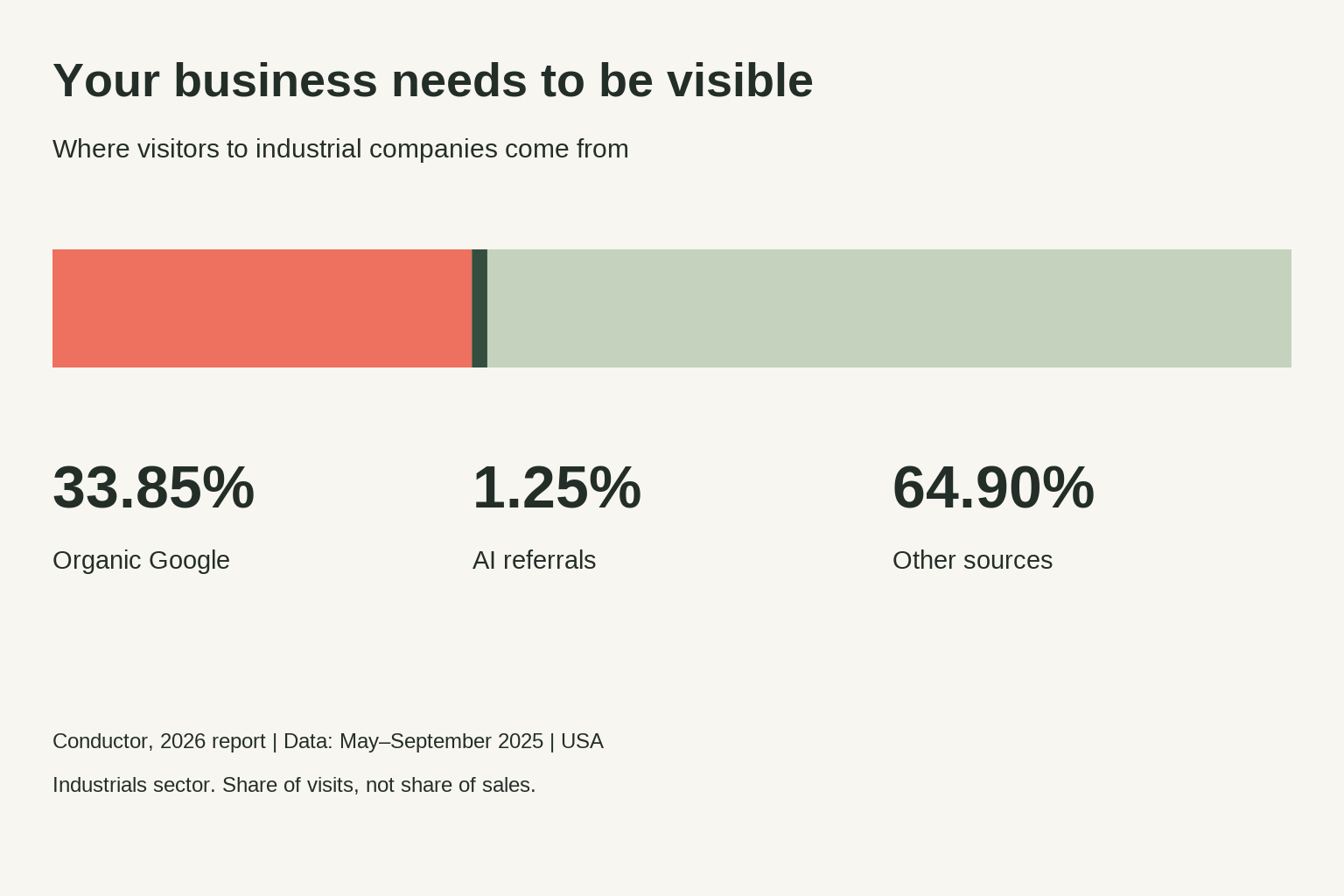
A recent traffic benchmark: Conductor, Industrials, 2026 report. Geography: United States. Period: May–September 2025. This is an industry benchmark from the provider’s sample, not a standard for every European B2B company.What data supports the chart?
The Conductor methodology analyses traffic across 1,215 enterprise customer domains. The chart’s shares relate to Industrials, not the entire sample. Organic Google includes visits attributed to that channel, including Google’s AI features; AI referrals are visits from other AI services. These are shares of visits, not revenue.
01
Find an answer
The company appears in the context of the customer’s task.
02
Understand the approach
The customer explores the explanation, expert and supporting evidence.
03
Return to the decision
They compare the offer and enquire with a specific question.
04
Make a purchase
If the offer, price and sales process meet their needs.
This is a possible journey to validate through analytics. Extra visits do not prove brand recall. We assess awareness through branded search, return visits and surveys; sales through qualified enquiries and deals.
COVERING CUSTOMER QUESTIONS
One knowledge base. Many ways to discover your company.
Buyers ask different questions: “Why did this happen?”, “How can we test a solution?”, “What should we choose?”, “What does implementation cost?” Connected content can answer different formulations and bring someone back to the same company at several stages of their decision.
Organic search
A page can appear for many relevant searches, including wording that has no dedicated ad. After publication, it can keep attracting visitors without paying for every click. Reach depends on demand, competition, indexing and quality; creating and maintaining content still requires investment.
Paid search
It allows faster demand testing and control over impressions. Reach depends on budget, auctions, targeting and settings. Modern campaigns can expand search coverage, but reducing spending usually reduces paid impressions and clicks.
My approach: identify questions connected to real business needs, answer them through the company’s experience and link each answer to a useful next step. Advertising can test priorities; the knowledge base can develop into a lasting asset.
What is a company knowledge base and knowledge graph?
A knowledge base is published company information with clear sources, authors and update rules. A knowledge graph connects entities: the company, specialists, products, services, customer tasks, methods, evidence and markets.
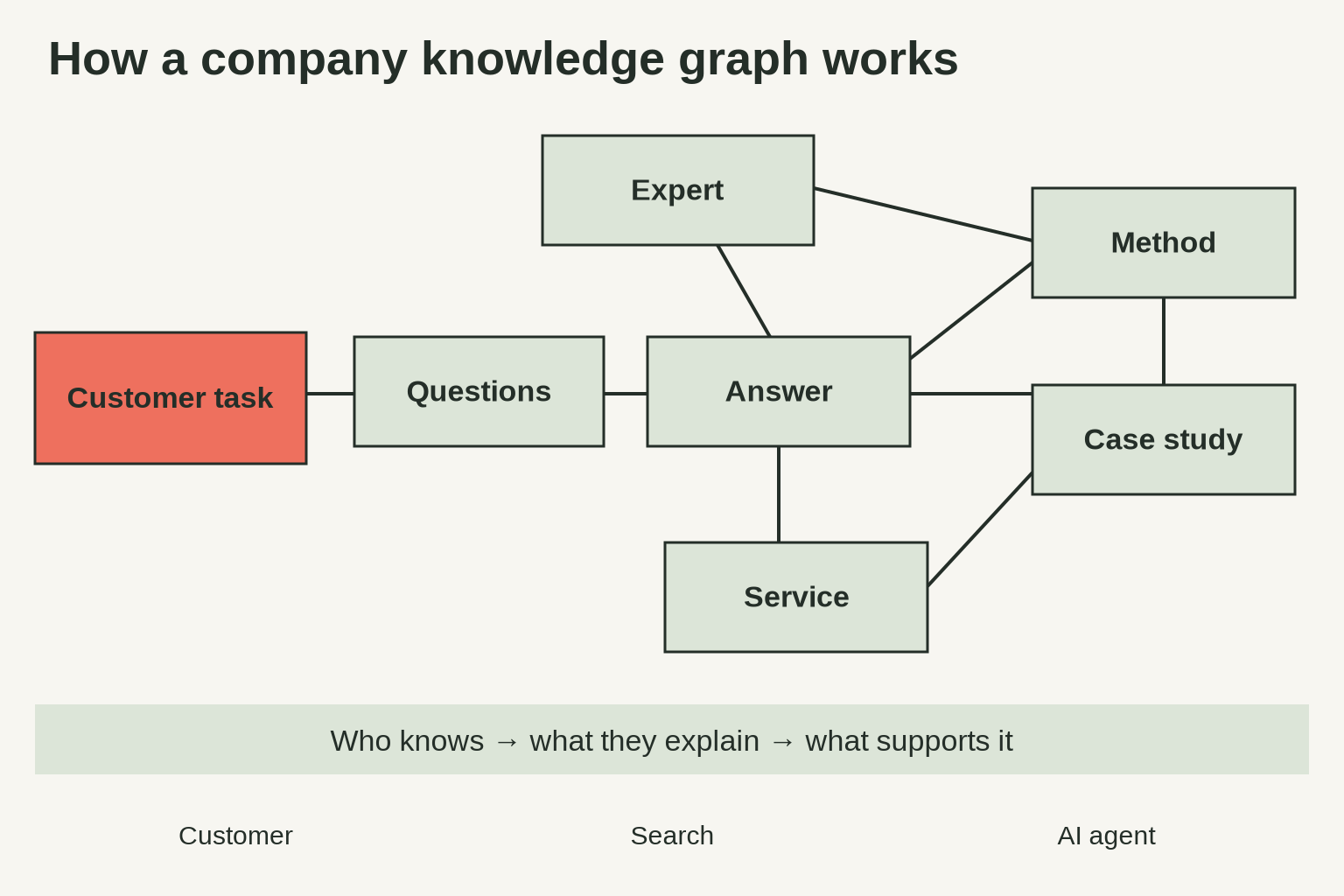
Customer question → expert answer → method → supporting case → relevant service → next step.
These relationships appear through page content, internal links, topic hubs and structured data that matches the visible text. A separate graph database, API or internal AI-agent integration may be needed for an extended system; its scope and cost are assessed separately.
A public knowledge base makes information available to people and systems reading the open web. It does not automatically connect the website to every AI system or guarantee inclusion in answers. Google states that its AI features use SEO fundamentals and require no special eligibility markup. Google’s guidance →
SYSTEM DIAGRAM
A graph is knowledge and the relationships between it.
A simplified diagram of the proposed architecture. Nodes represent questions, experts, answers, methods, cases and services. Lines represent semantic relationships expressed through website content, links and consistent structured data.
The base stores knowledge
For example, an article explains a problem, a case study describes completed work, and an expert profile sets out experience and responsibility.
The graph explains relationships
Who stands behind the explanation? Which method was used? What does the case substantiate? Which service addresses the task? Visitors gain context and can choose their next step.
An internal AI agent additionally requires retrieval, access permissions and answer evaluation. A website knowledge graph alone does not create this integration.
WHAT YOUR BUSINESS RECEIVES
Clear actions. Outcomes you can examine.
A better-informed first conversation
Customers can understand your reasoning, limits and approach before enquiring. We examine what they read and which questions they bring to the meeting.
Knowledge becomes less dependent on one person
Sales teams receive agreed answers, explanations and examples. The founder contributes to the content and then reviews the recorded wording.
A website that answers real questions
Content is built around buying situations. We compare search queries, customer enquiries and questions in industry communities.
A foundation for organic growth
You receive a topic architecture, published answers and technically accessible pages. We then measure discovery, visit quality and contribution to enquiries.
B2B SEO, AEO and GEO content strategy
Company knowledge base development connects expert-led content, semantic SEO, knowledge graph architecture and multilingual search. Answer engine optimization (AEO) and generative engine optimization (GEO) describe work on visibility in AI answers. The programme combines customer research, technical SEO and an ongoing content review process.
What the service includes
01 / Customer research
I investigate what changed in the buyer’s life or work, why they started searching, what they compare and what prevents a decision. I analyse queries, landing pages, advertising, available analytics and enquiries.
02 / Capturing expertise
I conduct written or spoken interviews with the founder and specialists. We reconstruct the reasoning: observation, hypothesis, action, test, outcome and limits of the conclusion.
03 / Knowledge architecture
I map questions and entities, identify core pages and their connections. Every piece of content has a task, audience, knowledge source and useful next step.
04 / Content and authorship
I create or improve service pages, expert articles, explanations, comparisons and case studies. Following substantive participation and approval, we identify the actual author or expert, editor where needed, dates and sources. Authorship records responsibility for the content.
05 / Technical accessibility
I check crawling, indexability, HTML, internal links, canonical tags, sitemaps and structured data. For multilingual SEO, I review language architecture, hreflang and local search intent, plus access restrictions affecting relevant search and AI crawlers.
06 / Updates and emerging questions
We monitor enquiries, search, local industry communities and Reddit. Questions are assessed by their commercial relevance and recurrence. We prepare expert-reviewed answers and update content when facts change and according to the agreed schedule.
Community questions are research signals. Discussion popularity does not establish market size or willingness to pay. Posting on the company’s behalf in communities is agreed separately.
MY METHOD
Understand why the search began. Then build the answer.
My SEO experience developed into work across the whole buying decision: customer, product, positioning, decision support and analytics. I begin with the product the company presents and the task the person is actually trying to solve.
Notice the contradiction. Do the query, page promise and next step match?
Ask “What if…”. The customer may be seeking a different outcome from the one the company usually describes.
Capture original knowledge. Which observations, decisions and constraints can the company genuinely explain from experience?
Make the reasoning accessible. Start with familiar context, then introduce new connections step by step. My 90/10 guideline is a personal communication technique.
Test the change. Compare behaviour and metrics across periods, accounting for actions, spending and seasonality.
In my BELSYS work, website languages matched those in which the team could serve demand. The principle remains: the language of a page must match the market, offer and ability to deliver the promise.
In the Loranmebel project, I observed what people examined in the showroom and moved decision-critical information online. The B2B principle is the same: understand what someone lacks to decide.
At PaperSpell, product strategy focuses on the next useful action after a document. The same question applies here: what can someone do with the information they receive?
On MarketerForever, my method is documented through interviews, working procedures, cases and a catalogue of business questions. You can examine how expert answers connect with services and practice. This demonstrates the structure; I do not yet claim enquiry growth from it.
These examples show the experience from which the service developed. They are not completed client implementations of the new system.
FIRST STAGE
Start with one service, one market and one question cluster.
We agree a limited pilot, select a service with a clear business task, record the starting position and create the first connected set of materials. We then decide what to expand.
Pilot deliverables
A map of customer questions and relationships between topics.
Interviews and approved expert insights.
An updated service page and an agreed number of related materials.
Author profiles and sources where justified.
A list of agreed technical changes and their implementation.
Baseline metrics, a measurement plan and an update schedule.
What we agree before starting
Website and CMS, markets, languages, access, interview scope, page count, specialist and developer involvement, timeline and budget. Translation is reviewed for terminology and meaning by someone familiar with the market.
Pricing follows a scope assessment. If the existing website needs diagnosis first, an SEO audit is available for €499. Its inclusion in any subsequent project is agreed separately.
Before starting, we record a baseline and agree an observation period. Search and AI-answer changes depend on recrawling, demand and external systems, so publication deadlines and outcome timelines are different measures.
Work delivered: answer quality and completeness, agreed expertise, page accessibility and current information.
Search discovery: indexing, queries, impressions and visits by selected topic and language.
AI visibility: observed mentions and citations against a recorded question set, with date, system and checking context. This is a sample, not a share of all AI answers.
Business journey: service-page visits, relevant enquiries, conversation quality and recorded enquiry sources.
Greater visibility does not establish higher revenue. Sales measurement requires connected analytics and sales-team data. AI outputs vary by user and query; recommendations cannot be guaranteed.
Questions before starting
Can this work alongside our existing SEO agency?
Yes. Responsibilities can be shared: your agency manages ongoing SEO; I focus on customer-task research, interviews, knowledge architecture and substantive content enrichment. We agree responsibilities before starting.
Why interview the founder?
Interviews uncover information unavailable in generic search: how you make decisions, where you were wrong, which patterns you see and which promises you can substantiate. Those insights are approved and explained in language buyers understand.
Can we just add schema.org and llms.txt?
Markup describes content; it does not create expertise or a useful answer. Additional files may serve individual systems, but they provide no universal entry into AI results. We start with accessible, accurate content.
Why update published articles?
Products, terms, rules and buyer questions change. Each material has an owner and review interval; significant changes trigger a review of the content and connected pages.
Can we use the base for our own AI assistant?
Yes, after defining access, formats, data rights and quality criteria. Retrieval, API or assistant integration is a separate stage. Public publication alone does not create it.
Which knowledge is still locked inside your company?
Send your website, core services, markets and the questions customers repeat before buying. Our first conversation identifies which part of the knowledge base makes sense to build first.